
Cycling Science Digest ·
Limited weight in your home gym? Read this
Listen to this issue as a podcast
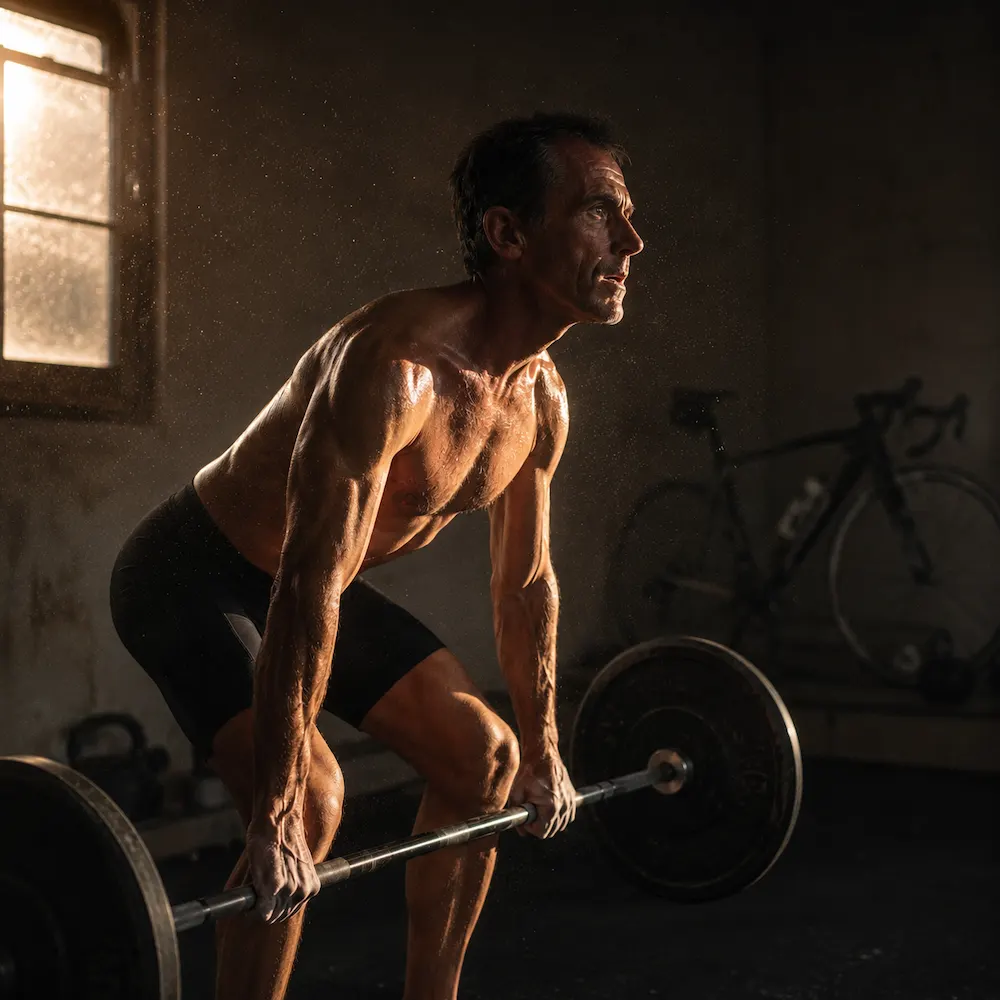
Most riders who lift eventually hit the same wall. The weight stops going up. You add a kilo, the reps fall apart, and you start to wonder whether you have simply run out of road. This matters more as you get older, because heavier and heavier loading is not always the smart or safe way to keep progressing. And yet strength still matters, for durability, for muscular endurance, and for staying resilient late in long rides.
A new study looked at what to do when adding weight is no longer the answer.
Over eight weeks, trained lifters worked twice a week starting at 80 per cent of their one-rep max. The progression began simply, by adding reps with a fixed load. When that stalled, they switched to one of two methods. The first was drop sets: keep going past failure by immediately cutting the load by 20 per cent. The second was rest-pause: take a very short break, around thirty seconds, then pick the same weight back up and keep working. Both are ways to keep pushing hard reps without loading the bar heavier.
The results were close to identical. Lean soft tissue mass rose by roughly 1.4 kg with drop sets and 1.2 kg with rest-pause. Bench press strength improved by about 12.3 kg with drop sets and 9.5 kg with rest-pause. Body fat stayed flat in both groups. The drop set numbers looked slightly better on paper, but the difference was not statistically conclusive. Weekly volume was similar across both methods, which is the real point. The specific trick you use to add hard reps matters less than making sure the stimulus stays demanding.
A few honest caveats. The study was short, the group was small, and it was mostly men. Muscle mass was estimated indirectly. And the loads were not re-adjusted as the lifters got stronger, so the relative intensity likely drifted down over the eight weeks. Treat this as a useful direction, not a rule.
What to do with this
Racers: Keep your heavy strength work in place through base and early build. But when a lift plateaus, do not force the weight up out of ego. Add a rest-pause cluster or a single drop set on your main lift to keep the stimulus high while you protect your joints and your ride quality the next day.
Big-hour riders: Strength is your insurance against fading late, but it competes with your riding for recovery. These methods let you keep progressing on two short sessions a week without adding sets or dragging the session out. That is exactly the trade you want.
Time-capped riders: This is where these tools shine. If you only have two 30-minute gym windows a week, rest-pause and drop sets let you keep adding productive reps without needing more time or a bigger rack of plates. Pick one main lift, take it near failure, and use one of these methods to squeeze out the last honest reps.
For all three, the principle is the same. Progression is not only about heavier. It is about keeping the effort genuinely hard when the weight can no longer climb.
Vargas-Molina S, Garcia-Palumbo A, Petro JL, Bonilla DA, Garcia-Sillero M, Carbone L, Schoenfeld BJ, Benitez-Porres J. Comparison of Repetition-Based Progressive-Overload Strategies in Resistance Training: Rest-Pause Versus Drop Sets. Scand J Med Sci Sports. 2026 Jul;36(7):e70327. doi: 10.1111/sms.70327.
On my mindWhere cycling sits in your life
The last two videos I put out were not my usual thing. No power numbers, no intervals, no pacing models. Just some thoughts I wanted to get out about life, and where cycling actually sits inside it.
Here is what I keep noticing as a coach. The training question and the life question are usually the same question. Where are you right now? What energy do you actually have? What have you let into your life, and in what order? I see this play out in so many different ways, and it rarely looks the way people expect. Two riders with the same numbers can be in completely different places, because one has room in their life for the work and the other is quietly running on empty.
None of this applies to everyone, and I know that. It was more that these felt like important things to say out loud, so I said them. What I am curious about now is whether they landed. If you watched either video and something in it resonated, or did not, hit reply and tell me. I read every response.
Damian
Get the Digest free, every Sunday.
One short, useful email a week: the studies, the experiments, and the patterns I’m seeing across 20,000+ training files.