
Cycling Science Digest ·
What 6,589 Gran Fondo finishers tell us about pacing.
Listen to this issue as a podcast
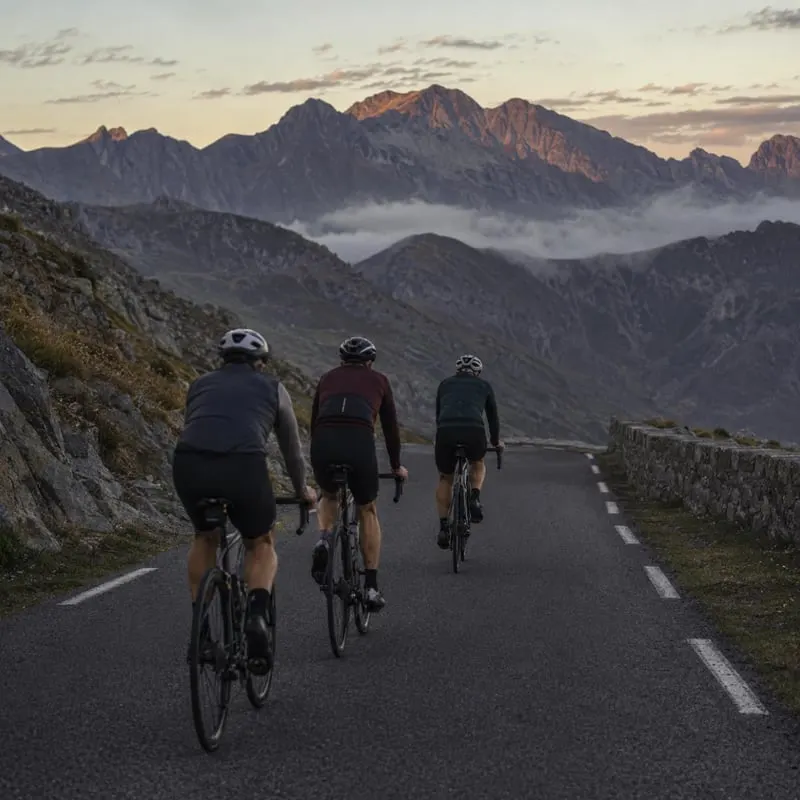
You line up for the biggest event of your year and the first hour disappears in a blur. Someone jumps, the pace lifts, and it feels wrong to sit up. So you don't. Then the deciding climb arrives and the legs aren't there.
It's the opening 40 km. You know the number you're meant to hold. You're 10 to 15 watts over it, breathing harder than the plan called for, telling yourself you'll settle in a minute. You don't quite settle. By the last big climb you're paying for it, and by the run-in you're being caught by riders you were ahead of at kilometre 30.
A new study looked at exactly this, using public split data from the 2025 Quebrantahuesos: a 197.2 km Gran Fondo through the Pyrenees, with major climbing and seven official timing splits. After excluding non-finishers and incomplete data, the researchers analysed 6,589 finishers, grouped into 30-minute finish-time bands from under six hours to over eight and a half. They tracked how relative speed and pacing consistency changed across the race, then ran clustering to find pacing profiles independent of finish time.
The fastest riders didn't start fastest. At the first checkpoint they were running slower relative to their own race average than the slower groups were, and it wasn't close. They also paced more consistently overall than every group behind them. That consistency effect was real but modest on its own, so it's not the whole explanation.
The separation showed up later. Through the decisive mid-race climbs the fastest riders spent proportionally less time than everyone else, meaning they simply moved better through the sections that mattered. And the finish line produced the biggest gap of the entire race. When the researchers clustered riders purely by pacing pattern rather than finish time, the best cluster wasn't the one that went out hardest. It was the one that started restrained and got stronger through the big climbs.
Worth being straight about what this is and isn't. It's an observational study of self-selected pacing, not a controlled trial, so what it shows is a strong association between restrained early pacing and better late-race performance, not proof that copying the pattern guarantees the result. One event, one edition, an overwhelmingly male sample, and split times only, no power, heart rate, or GPS. Odds are the pattern generalises to other long, hilly mass-participation events with a clear decisive climb. The exact numbers probably don't.
Why it happens is straightforward: durability. Early aggression burns through glycogen faster, accelerates cardiovascular drift, adds thermal and neuromuscular load. Hold something back in the first hour and you've still got capacity when the climb that decides the day shows up. Spend it early and you don't. This isn't an argument for riding evenly, speed should vary hugely with terrain in a Gran Fondo. It's an argument for spending effort honestly and keeping something for the parts of the course that actually decide it.
What you do with this depends on which rider you are.
- If you're time-capped: the instinct is to go hard early because long days are rare. Fight it. Use the first hour to protect your options. You've already done the training, don't burn it in the opening kilometres.
- If you're over 50: the instinct is to push early to guarantee a finish. It backfires. Sit a notch under your ceiling until the second half.
- If you're chasing a result, or it's a new event for you: the instinct is to match whoever's around you. Don't. Race the course, not the group. Positions change on the decisive climb and at the finish, and you want something left when they do.
The first hour is the easiest place to lose a Gran Fondo, and the hardest place to protect yourself from.
Source. Sánchez-Jiménez JL, Priego-Quesada JI, Oficial-Casado F. Pacing strategies in Gran Fondo cycling: a large-scale analysis of the Quebrantahuesos race. Sport Sciences for Health. 2026.
On my mindFuel the work you're actually doing
I keep having the same conversation, with several SEMIPROs and with other coaches. The information problem in cycling nutrition is basically solved. Everyone knows carb intake is higher now. Higher grams per hour on hard days is normal advice, not radical.
The principle's simple: fuel the work you're actually doing.
People do the opposite anyway, because information isn't a habit. Reading a target intake number isn't the same as opening the cupboard on a Tuesday morning and having the food ready. The knowledge sits on a screen. The behaviour has to sit in your week.
That distinction matters because training is what makes you faster, and under-fuelled training doesn't do what fuelled training does. You end up doing the sessions without getting what the sessions are for.
And it adds up. Slower adaptation, longer recovery, a season that never quite peaks. Not because the plan was wrong. Because half its carbs never got eaten.
That's on us as much as anyone. We need to get better at SEMIPRO at making the fuelling habit real, not just prescribing it.
So here's the nudge for the week: pick one hard session in the next seven days and pre-place the food and drink the night before. Bottles filled, gels counted, breakfast staged.
— Damian
Get the Digest free, every Sunday.
One short, useful email a week: the studies, the experiments, and the patterns I’m seeing across 20,000+ training files.