
Cycling Science Digest ·
Your Recovery Nutrition Is Probably Wrong—Here’s the Real Science
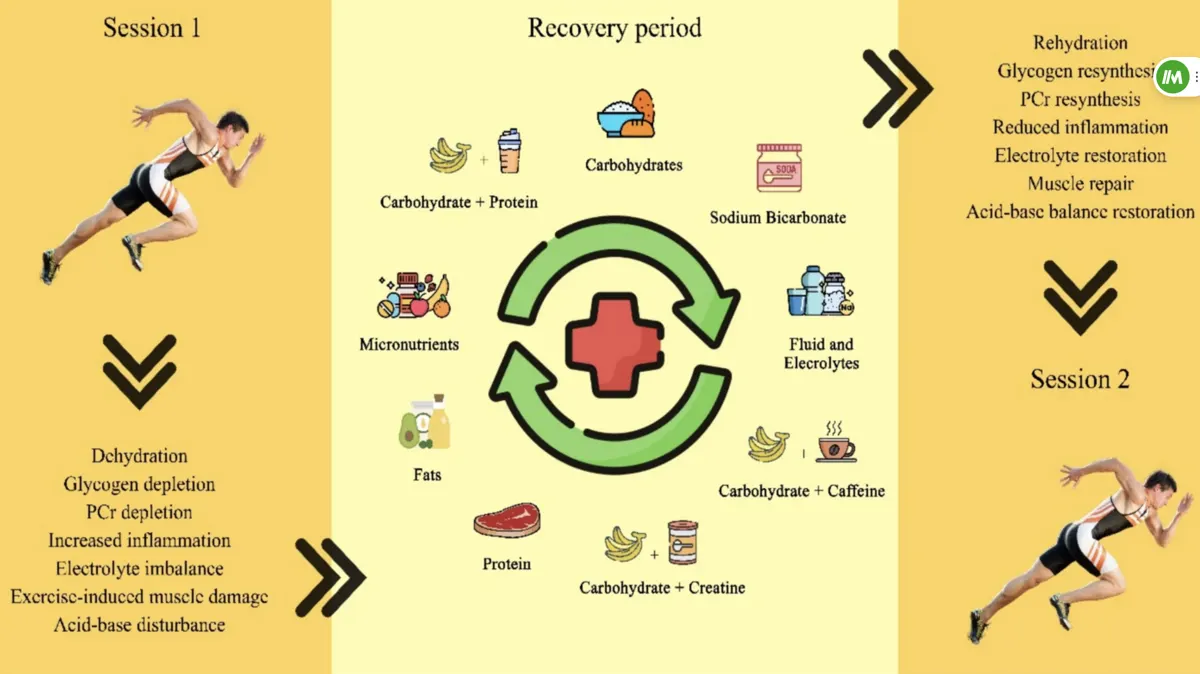
A new 2025 narrative review published in Sports Medicine, led by Alireza Naderi, Jeffrey Rothschild, Tim Podlogar and others, provides a comprehensive update on nutritional strategies to accelerate recovery and improve subsequent performance when recovery time is limited—anywhere from 2 to 24 hours.
This review is especially relevant for cyclists training twice a day, racing stage events, or stacking hard training days, where fast recovery directly impacts performance.
What sets this paper apart is its focus not just on restoring glycogen or reducing muscle damage, but on actual improvements in subsequent performance.
The authors evaluate each nutritional strategy—carbohydrates, protein, fat, hydration, creatine, caffeine, sodium bicarbonate, and micronutrients—based on the strength of evidence and whether it meaningfully improves performance in the next session.
This isn’t a rehash of old advice. It challenges assumptions, confirms best practices, and clarifies the conditions under which supplements actually work. For cyclists aiming to train harder or race faster with limited recovery time, this review offers one of the most practical, science-backed roadmaps available.
Key Takeaways for Cyclists
What’s Changed
- Glucose + Fructose is Better Than Glucose Alone (Sometimes) - Glucose remains the most effective for muscle glycogen. - Adding fructose helps restore liver glycogen faster and reduces GI discomfort—especially important for <8h recovery windows.
- Protein Only Adds Value When Carbs Are Suboptimal - If you’re not getting 1–1.2 g/kg/hr of carbs, protein co-ingestion helps. - Otherwise, the benefit is marginal but may still matter at the elite level.
- Creatine Works, But Not Immediately - It boosts glycogen stores, but only after multiple days or longer recovery windows. - Not useful for short-term recovery (<6h).
- Caffeine Is Conditional - May boost glycogen resynthesis if carbs are low. - Mixed results on performance. Can disrupt sleep and impair next-day output.
- Hydration Strategy Needs to Be Smarter - Water alone is insufficient. - Milk, rehydration solutions, and salty drinks are more effective post-ride. - Cola, tea, and even some sports drinks = no better than plain water.
What’s Confirmed
- Post-exercise carbs are still the cornerstone of recovery: 1–1.2 g/kg/hr.
- Fast-acting, high-GI carbs work best.
- 20–40 g protein post-exercise is ideal, with 3–4h spacing for meals.
- Hydration targets: 150% of fluid lost during exercise.
Practical Recovery Stack for Cyclists (0–4h window)
- 1–1.2 g/kg/hr carbs (glucose or glucose-fructose blend)
- 30 g high-quality protein
- Rehydration drink (oral rehydration solution, or equivalent)
- Caffeine only if sleep is unaffected and carbs are suboptimal
Skip or Use with Caution
- Micronutrient megadoses: reduce muscle damage but may blunt long-term adaptations.
- Fat in recovery meals: doesn’t hurt glycogen resynthesis but doesn’t help performance either.
Impact
For cyclists training twice a day or racing multiple stages, this review gives precision tools for the hours that matter most. It confirms what works, corrects what doesn’t, and highlights when supplements like creatine or bicarbonate make sense.
Link to study
https://doi.org/10.1007/s40279...
We’re Hiring: Video Editor
We’re looking for a video editor to join the team. Flexible hours. Must be fast, detail-oriented, and comfortable working with YouTube content.
Interested?
Reply directly to this email to apply.
Know someone perfect for the role? Please forward this to them.
On my mindEarned Grit
There’s a weird kind of satisfaction in getting knocked down repeatedly and choosing not to quit. I’m not saying you want to live there forever, but if you can take a couple years of losses and keep showing up, there’s serious value in that. Win or lose, you prove to yourself that you can take hits and keep swinging. That resilience—staying in the fight—is a win in itself.
Catch you next week,
Damian
Get the Digest free, every Sunday.
One short, useful email a week: the studies, the experiments, and the patterns I’m seeing across 20,000+ training files.