
Cycling Science Digest ·
Forget FTP Intervals—Your Race Pace Could Be Better
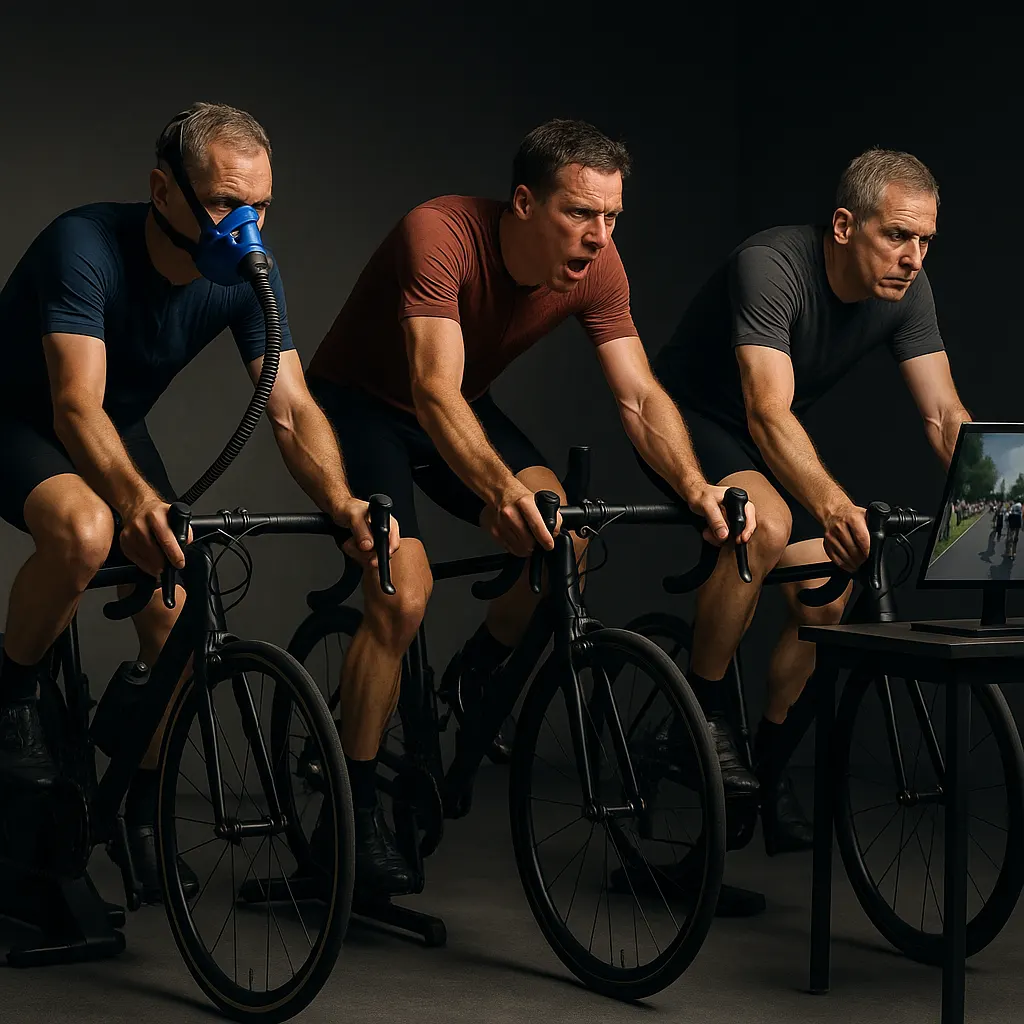
I know it’s about running, but this study intrigued me because it aligns closely with how I think about cycling training—specifically, the difference between top-down (race-specific) and bottom-up (physiological) approaches.
In his PhD research, Raffaele Mazzolari compared three distinct methods for prescribing high-intensity interval training (HIIT) to distance runners:
- Physiological Approach: Athletes trained at a personalised intensity midway between their second lactate threshold and peak speed. Intervals were individually tailored, lasting half of the athlete’s maximum sustainable effort duration, with a 2:1 work-to-rest ratio.
- Race-Pace Approach: Runners completed standardised intervals (1,000 m) at 110% of their 10k race pace, with a fixed 300 m jog recovery (~2 minutes).
- Standardised Approach: A one-size-fits-all training protocol based on group averages from the physiological group, without individual adjustments.
Key Findings:
- Physiological training led to the greatest improvement in VO₂ max, increasing aerobic capacity by 5.0 ml/kg/min more than the Race-Pace method and 3.5 ml/kg/min more than the Standardised approach.
- Surprisingly, Race-Pace training resulted in the best actual performance gains, improving 10k speed by 0.4 km/h more than the Physiological approach, despite smaller gains in VO₂ max.
- Standardised training performed the worst on both measures, suggesting individualisation is critical.
What does this mean for cycling?
If we translate this into cycling terms, it raises an important question: Is your priority improving raw physiological capacity (e.g., VO₂ max, FTP), or should training directly mirror race demands (e.g., pacing simulations, form finders)? This study hints that both approaches have merit—but prioritising race-specific intensity might yield the best practical performance gains, even if physiological metrics improve less dramatically.
Ultimately, it supports the idea that training closer to your actual race conditions might be more beneficial when it comes to measurable race performance, whereas purely physiological-based intervals could give broader fitness improvements that don’t always directly translate to faster times.
Reference: https://pubmed.ncbi.nlm.nih.go...
Ready to boost your durability?
Grab my Road Durability VO₂max Plan—a smart, structured approach to training that builds lasting performance.
On my mindNumbers Aren’t Enough
I was on a call this week with an athlete, and something occurred to me: numbers alone aren’t enough. This athlete was training consistently, even following structured plans, yet he felt lost—unsure of what his numbers really meant, unaware of his true limits, strengths, or how to plan strategically for upcoming events.
It’s easy to assume that structured training naturally leads to clarity. But without understanding the why behind every session, or knowing exactly what the metrics tell you about your body and performance, it’s just effort without purpose. Real progress happens when you see how today’s session fits into your broader goals, giving meaning to every pedal stroke.
And here’s something else that stood out: stress doesn’t discriminate. Your body doesn’t care if stress comes from work, family, or intervals—it all adds up. Effective training isn’t just about intervals and watts; it’s about balancing life’s total stress load.
Knowing yourself—your limits, your strengths, and how life’s demands interact—is essential. Because when you truly understand your numbers and yourself, choosing goals, planning training, and staying motivated becomes clear, purposeful, and effective.
Damian
Get the Digest free, every Sunday.
One short, useful email a week: the studies, the experiments, and the patterns I’m seeing across 20,000+ training files.