Juan: 4kg lost and 55W gained in 6 months
Juan shows the broader SEMIPRO performance picture: structured training, nutrition changes, better durability, and a return of confidence and enjoyment on the bike.
Lost 4kg and gained 55W in 6 months
Result at a glance
- Main outcome
- Lost 4 kg and gained 55 W
- Timeframe
- 6 months
- Rider context
- Busy cyclist seeking structure and guidance
- Product used
- Coaching
Where this rider actually started.
Burnt out and frustrated after more than a year of training that had initially promised progress and then stalled.
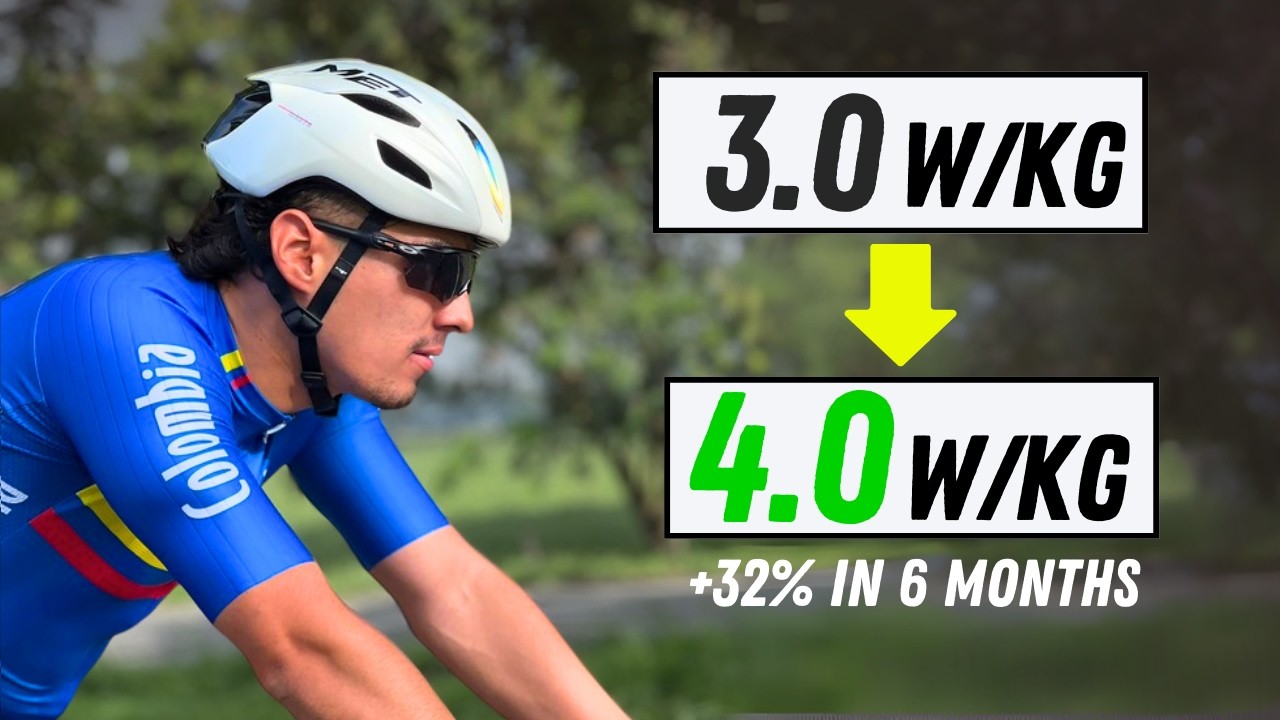
Critical power 223 W at 73.6 kg, roughly 3 W/kg at threshold. Every ride was draining and overly intense, and the fatigue was not producing improvement.
Goal. Break a plateau and get past a threshold stuck at around 3 W/kg.
Main constraint. A busy schedule. The block averaged 7.7 structured hours a week, including a planned no-bike holiday.
The decisions behind the result.
- Weeks 1–4: about 4h45 a week, mostly low intensity plus general strength, building an aerobic foundation. Small doses of every intensity zone were kept in so no energy system went cold.
- Weeks 5–8: volume up to about 8 hours, with longer low and moderate-intensity rides and lactate threshold sets of 4×8 minutes near 95% of critical power.
- Weeks 9–12: about 7 hours a week around a planned no-bike holiday, with cross-training used to hold chronic load steady rather than pretending the break was not happening.
- Weeks 13–16: about 8h30 a week of race-specific intensity — VO2max blocks and anaerobic work — into his first target event.
- After that event went badly, nutrition changed on the athlete’s own initiative: junk food and sauces cut, proper fuelling before and during rides, alcohol substantially reduced.
- Weeks 17–24: close to 10 hours a week rebuilding endurance capacity and durability, with each session aimed at a named weakness rather than at generic fitness.
What was actually measured.
Grouped by what kind of evidence each number is. A race result, a recorded power file, a model estimate and a rider’s own impression do not carry the same weight.
Race or event result
- First target event
- Finished well below expectations, feeling sluggish and heavy. This is the point in the six months where nutrition changed.
Recorded or tested power
- Durability, recorded in training files
- 5-minute power after 1,000 kJ rose from 216 W to 283 W. Fresh 5-minute power rose from 262 W to 308 W. Fatigue-induced power loss fell from 46 W to 25 W, a 46% reduction.
Modelled power
- Critical power
- 223 W to 278 W, a 55 W change. Critical power is modelled from a set of maximal efforts rather than measured in a single test.
- Watts per kilogram at threshold
- About 3.0 to 4.0 W/kg. This figure moves with both the power gain and the weight loss, so it overstates the training effect on its own.
Training consistency
- Structured hours
- 154 structured hours across the period, averaging roughly 7.7 hours a week.
Body mass
- Weight
- 73.6 kg to 69.3 kg, about 4.3 kg, driven by the dietary changes in the final two months.
Subjective feedback
- Group riding
- Went from struggling to hold the wheels of more experienced riders to taking pulls on the front.
The useful takeaway.
- Supports SEMIPRO as a coaching system for multi-factor performance change.
- Adds a longer time-horizon proof point beyond 12-week blocks.
- Shows why the method talks about the whole athlete, not only workouts.
- Supports the durability claim with a directly measured before-and-after: power loss under fatigue nearly halved.
What this example does not prove.
- Training, nutrition, alcohol intake and body mass all changed inside the same six months. The 55 W gain cannot be attributed to the training alone.
- Critical power is a model estimate fitted to maximal efforts, not a single laboratory test.
- The watts-per-kilogram figure combines a power gain with a weight loss and should not be read as a measure of the training effect.
- Individual result, no control group.
- The durability numbers come from training files recorded on different days under different conditions, not from a controlled protocol.
- A rider who had already plateaued for a year had obvious headroom. That is not the same starting position as a long-optimised athlete.
Where this comes from.
Source video with full transcript, including athlete interview
How This Cyclist Lost 4kg AND Gained 55 Watts in 6 Months (Full Breakdown)
Full transcript
Related evidence
Tom: 47W FTP gain in 12 weeks
52-year-old gravel racer training 7–8 hours per week · 12 weeks
View the evidence →Athlete case studyJohn: endurance power doubled across the season
New father, full-time worker and road/gravel racer · 21 weeks
View the evidence →Athlete case studyJasper: 24 minutes faster at a favourite gran fondo
Cyclist in his 50s preparing for a gran fondo
View the evidence →