Cycling Science Digest ·
Bicarbonate for the hard effort late in a ride
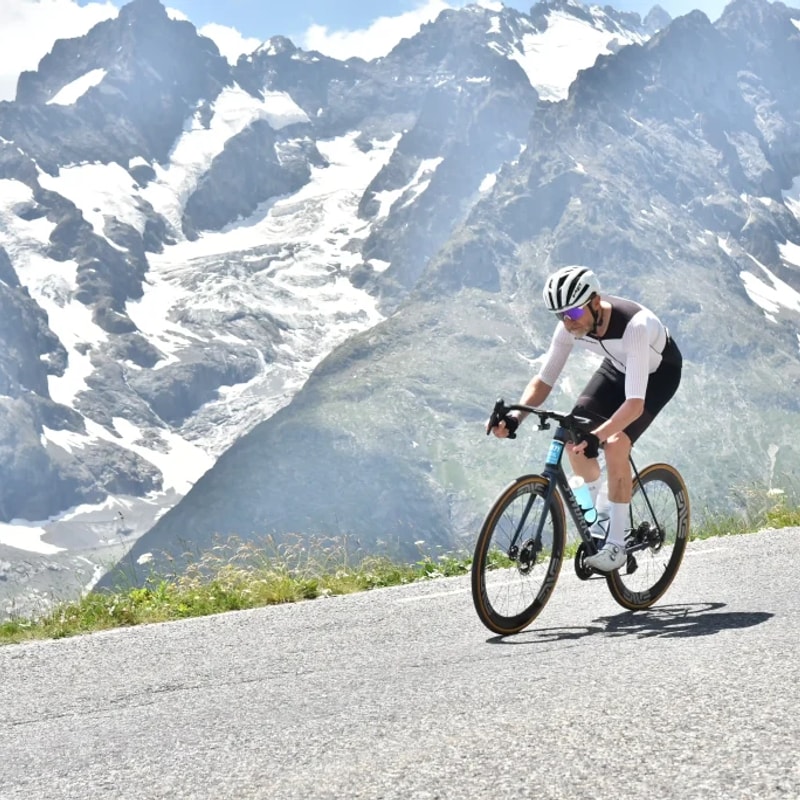
The last climb of a long ride can feel quite different from the first. Lifting the effort for ten or fifteen minutes asks more of you than it did when you were fresh.
A new study looks at whether bicarbonate in carbohydrate gels can help with that final effort. It was taken during three hours of riding, without a bicarbonate loading dose beforehand.
Eleven trained cyclists, eight men and three women, completed both conditions in a randomised crossover study. They averaged nine hours of training a week and were already used to consuming at least 80 grams of carbohydrate an hour.
They rode for three hours just below their first ventilatory threshold, consuming 80 grams of carbohydrate an hour in both conditions. In one, four gels also provided a total of 18 grams of sodium bicarbonate and 2 grams of potassium bicarbonate spread through the ride.
Afterwards came three six-second sprints, a two-minute time trial and a twelve-minute time trial, with recovery between tests.
The twelve-minute effort improved with bicarbonate: 251 watts compared with 239 watts, a mean difference of 12 watts. The researchers reported an average individual improvement of roughly 6%. There was no significant difference in the shorter tests.
Both conditions still produced less power than when the cyclists were fresh. Bicarbonate reduced the loss in the longer effort; it didn’t remove fatigue. And this benefit appeared on top of substantial carbohydrate intake, rather than rescuing an under-fuelled ride.
Bicarbonate helps buffer the changes in acidity associated with hard exercise. Blood bicarbonate was higher with the supplemented gels, consistent with that explanation. The cyclists weren’t shown to use more carbohydrate or find the steady riding easier.
Gut symptoms were mild and similar between conditions. These riders had practised with the gels, drank water alongside them and were used to high carbohydrate intakes. They also rated the bicarbonate gels as less pleasant. Similar symptoms in this group don’t guarantee everyone will tolerate them.
Eleven riders is a small sample. Different gel tastes and textures prevented full blinding of the riders and the researcher running the trials. This was steady laboratory riding followed by specific tests, rather than a race with repeated attacks. It also didn’t compare taking bicarbonate during the ride with taking it beforehand.
What you do with this depends on which rider you are.
If you’re time-capped: look first at whether you’re consistently fuelling the longer rides you do have. These cyclists were already comfortable with a high carbohydrate intake. Adding another ingredient is a separate decision from getting that routine working.
If you’re over 50: the group’s average age was 37, so this isn’t a result established specifically in older riders. If bicarbonate is something you’re considering, discuss its suitability with a sports dietitian before copying the study protocol.
If you’re chasing a result or facing a new event: a hard climb late in a long ride is a closer match to this finding than a finishing sprint. If you decide to explore it with your support team, do that in training, with the fuelling and drinking routine you intend to use.
The interesting finding is a little more power for a sustained effort when you’re already tired. The fuelling still comes first.
Source. Norte BR, Hickman A, Muñoz Megias A, et al. Bicarbonate and Carbohydrate Co-Ingestion During Exercise in a Novel Gel Format Improves Time-Trial Performance After 3 h of Moderate-Intensity Exercise in Trained Cyclists. Scandinavian Journal of Medicine & Science in Sports. 2026;36:e70373. doi:10.1111/sms.70373.
OFFICIAL KIT PARTNER
Check out the Lameda kit I’ve been riding in here: https://www.lameda.cc/SEMIPRO
Use code SEMIPRO for 15% off eligible cycling kit (I earn a commission on eligible purchases).
On my mindHow much of an offseason do you need?
Offseasons have been on my mind. Knowing when to take a break, and how much of a break to take.
I think the time you have available to train should be part of that decision.
If your normal week is already squeezed, I tend to favour a shorter break. You have fewer hours available to build back up afterwards, so a big drop in training can take longer to come back from. Someone with much more time to train has more room to take a longer break and rebuild.
I used to lean more on strict numbers for this, like reaching a particular TSB. Now I’m more interested in the person in front of me. It’s often as much about availability as age.
That doesn’t mean you should keep pushing because you’re busy. Sometimes you simply need to unload.
It also helps to look at the season you’ve actually had. Have you trained consistently for months, or did a holiday give you a few weeks away from your usual routine? Have you already had a couple of weeks off through illness? Those are different situations, but both belong in the conversation about what break you need now.
If you haven’t had a proper change of pace, I’d usually want at least a week of unloading. That doesn’t have to mean a week of doing absolutely nothing. It might include three or four days off the bike, then a gradual return, or some easy activity you enjoy that gives you a break from cycling.
If a holiday has already given you that change, you may not need to add another long break simply because the calendar says it’s the offseason. And next time, perhaps enjoy the holiday a little more rather than trying to fit every session around it.
Before deciding how much time to take, look at what you’re recovering from and how much time you’ll have to train afterwards. That’s a more useful starting point than someone else’s offseason.
— Damian
PS. If you’re thinking about how to structure the months ahead, The Winter Block brings together sixteen weeks of training, weekly feedback from a coach and a small group to train alongside. Training starts 2 November, and you can follow the plan indoors or outdoors.
See what’s included in The Winter Block →
Semi-Pro Limited, Suite 1104, 70 Queen's Road, Central, Hong Kong.
Get the Digest free, every Sunday.
One short, useful email a week: the studies, the experiments, and the patterns I’m seeing across 20,000+ training files.