Cycling Science Digest ·
What the new bicarbonate study adds
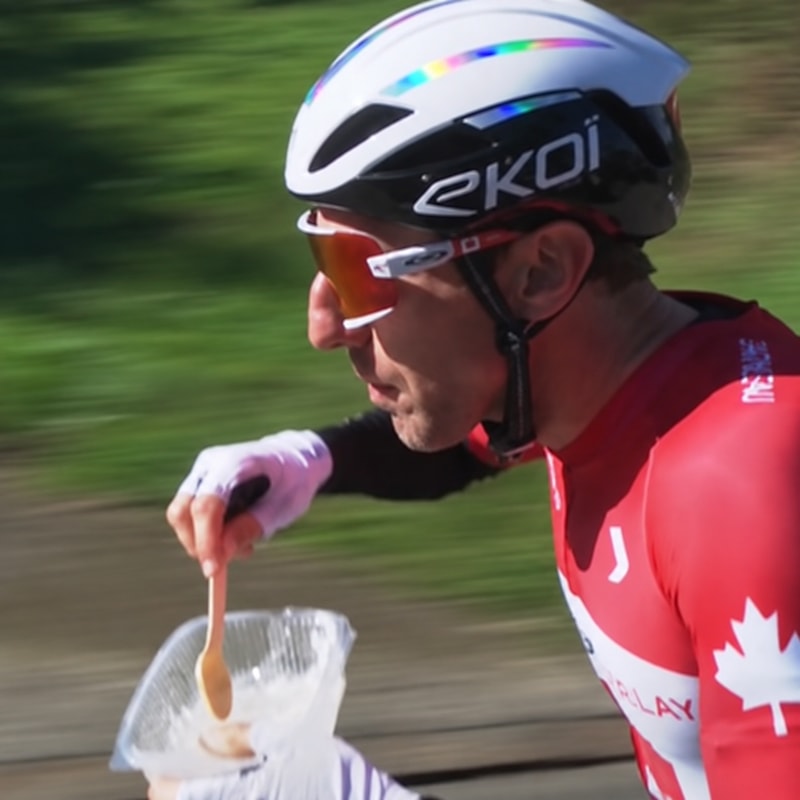
A hard effort near the end of a ride can ask quite a lot of you, even when most of the riding has been steady. That’s one reason I’m interested in the research on bicarbonate.
We’ve been talking lately at SEMIPRO about supplements and the trends that come and go. Bicarbonate has been studied for a while, and this new paper adds something useful. It helps us be a little more specific about where it might fit.
Bicarbonate helps buffer the changes in acidity associated with hard exercise. Taking it can help hydrogen ions move out of the working muscle, which is one way it may help you sustain those efforts. There are practical limits, including whether your stomach tolerates it.
The new study tested 24 well-trained cyclists, 15 men and nine women, in a randomised, double-blind crossover. Each completed bicarbonate and placebo trials. They took about 0.26 g/kg two hours beforehand, using mini-tablets in carbohydrate hydrogel; the placebo matched the format and carbohydrate.
After a step test came five five-minute blocks of repeated 40-second hard efforts, then four 30-second sprints. Mean hard-effort power was about 2% higher with bicarbonate, with more time above 90% of VO₂max. Sprint power also improved about 2%. Cycling economy didn’t improve. Most gut symptoms were similar, although burping increased.
These were mostly young adults, and responses varied. The study didn’t follow changes in fitness over a training block or recovery afterwards, so those questions remain open.
An earlier study adds some context. In 2021, Dalle and colleagues reported on 11 trained men who completed a 90-second all-out effort after three hours of cycling. With bicarbonate taken before and during the ride, average power was 541 watts, compared with 524 watts on placebo—about 3% higher.
It’s a small study, but it suggests the benefit can still be there after a longer ride. It tested the combined supplementation plan, so we can’t separate the contribution of the doses taken during the ride. And the result concerns that final effort, rather than an improvement across the whole three hours.
For me, that makes bicarbonate worth considering when repeated hard efforts, or a hard effort late in an event, are part of what you’re preparing for. I’d still want to understand how it fits the rider and the training before suggesting a change.
What you do with this depends on which rider you are.
If you’re time-capped: I’d first look at how you’re arriving at your key session—whether you’ve eaten, recovered and left enough time for it. That gives you a clearer starting point for deciding whether a supplement is worth considering.
If you’re over 50: these studies give us less to go on for your age group. A sports dietitian can help you consider whether bicarbonate is suitable, including how any health conditions or medication affect that decision.
If you’re chasing a result or facing a new event: think about the efforts you’ll need to make when you’re already tired. If you and your support team decide to try bicarbonate, use training to work through the practical details and see how you tolerate it.
It’s useful evidence to have when deciding what belongs in your own preparation.
Source. Feuerbacher JF, Bjerkeset M, Mølmen KS, Schumann M, Rønnestad BR. Sodium Bicarbonate Supplementation Enhances Repeated High-Intensity Interval Training Performance and Time Above 90% of V̇O₂max in Well-Trained Cyclists. European Journal of Sport Science. 2026;26:e70253. Published 18 September 2026. doi:10.1002/ejsc.70253. Dalle S, Koppo K, Hespel P. Sodium bicarbonate improves sprint performance in endurance cycling. Journal of Science and Medicine in Sport. 2021;24(3):301–306. doi:10.1016/j.jsams.2020.09.011. Background: Grgic J, et al. International Society of Sports Nutrition position stand: sodium bicarbonate and exercise performance. J Int Soc Sports Nutr. 2021;18:61. doi:10.1186/s12970-021-00458-w.
On my mindWhat will still matter in ten years?
I’ve been thinking about the future of coaching and how coaches and athletes will interact. I don’t think we’re there yet, but I think we’re getting closer to understanding which parts will change and which will stay much the same.
In ten years, I think people will still want someone who takes the time to get to know them. Someone they can talk to, who understands what they’re trying to do and is in their corner. That ongoing relationship will still matter.
At the same time, more of the complex calculations will probably disappear into the background. We’ll get outputs that are easier to understand and use, without needing to work through all the detail ourselves.
Someone will still need to connect that information with the person in front of them and decide what to do next. A conversation about how the week has gone can change how you interpret the numbers.
— Damian
PS. If you’ve been thinking about joining The Winter Block, there are a few days left to lock in the founding rate. Founding enrolment closes 30 September.
We already have a really good group locked in, and I’d love to see you join us. Sixteen weeks of structured training, indoors or outdoors, with a small group and individual feedback from a coach each week. We start 2 November.
A $25 deposit locks in the $499 founding rate. The deposit is fully refundable before the block starts.
Semi-Pro Limited, Suite 1104, 70 Queen's Road, Central, Hong Kong.
Get the Digest free, every Sunday.
One short, useful email a week: the studies, the experiments, and the patterns I’m seeing across 20,000+ training files.